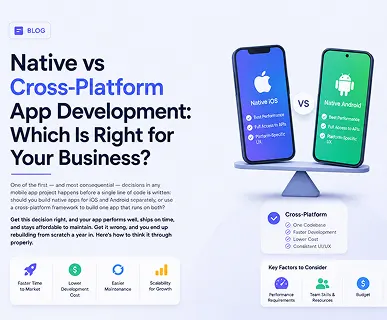
One of the first — and most consequential — decisions in any mobile app project happens before a single line of code is written: should you build native apps for iOS and Android separately, or use a cross-platform framework to build one app that runs on both?
Get this decision right, and your app performs well, ships on time, and stays affordable to maintain. Get it wrong, and you may end up spending significantly more on development, maintenance, or even rebuilding parts of the application later.
Here’s how to evaluate both approaches and choose the right solution for your business.
What Is Native App Development?
Native app development means building a separate application specifically for each mobile operating system.
For iOS, developers typically use Swift or Objective-C, while Android applications are commonly developed using Kotlin or Java.
Because the application is built specifically for its target platform, developers have direct access to operating-system features, device hardware, and native APIs.
Pros of Native App Development
- Excellent performance and responsiveness
- Full access to device hardware and operating-system features
- Faster access to new platform-specific capabilities
- Excellent support for advanced animations and graphics
- Highly optimized user experience for each platform
- Ideal for complex and hardware-intensive applications
Cons of Native App Development
- Separate codebases for iOS and Android
- Higher development and maintenance costs
- Longer development timelines
- Requires developers with different technical skill sets
- Features and updates may need to be implemented separately for each platform
What Is Cross-Platform App Development?
Cross-platform development allows developers to create applications for multiple operating systems using a shared codebase.
Popular frameworks include Flutter and React Native.
Instead of building two completely separate applications, developers can reuse a significant portion of the code while still delivering applications for both iOS and Android.
Pros of Cross-Platform Development
- One shared codebase for multiple platforms
- Faster development and deployment
- Lower initial development costs
- Easier maintenance and updates
- Faster MVP development
- Easier to maintain consistent features and design across platforms
- Excellent choice for most business applications
Cons of Cross-Platform Development
- Some advanced features may require native code
- Certain platform-specific features may require additional development
- Complex graphics-intensive applications may benefit more from native development
- Framework updates and third-party dependencies need to be managed carefully
Native vs Cross-Platform: What’s the Difference?
The biggest difference is how the application is developed and maintained.
With native development, iOS and Android applications are treated as separate projects. This provides maximum platform-specific control but requires more development resources.
With cross-platform development, a large portion of the application can be built from a shared codebase. This reduces duplication and allows businesses to launch on multiple platforms more efficiently.
For most standard business applications, modern cross-platform frameworks can provide excellent performance while significantly reducing development time.
Which Should You Choose?
There isn’t a single solution that works for every business. Your choice should depend on the application’s functionality, target audience, budget, timeline, and long-term roadmap.
Choose Native Development If:
- Your application requires advanced device hardware capabilities
- You are building a high-performance gaming application
- Your app depends heavily on AR/VR or advanced camera functionality
- You need extensive platform-specific functionality
- Maximum performance is the primary requirement
- You need immediate access to new iOS or Android features
Native development provides the highest level of platform-specific optimization and control.
Choose Cross-Platform Development If:
- You need to launch on both iOS and Android
- You have a limited development budget
- You want to launch your MVP quickly
- Your application is an e-commerce platform
- You are building a booking or appointment application
- You are developing a service-based application
- Your app is primarily content, business, or productivity focused
- You want simpler long-term maintenance
For many startups, SMEs, and growing businesses, cross-platform development offers an excellent balance between cost, development speed, and performance.
What About App Performance?
Performance is often the biggest concern when considering cross-platform development.
Modern frameworks such as Flutter and React Native have significantly improved the performance of cross-platform applications.
For applications such as:
- E-commerce apps
- Booking platforms
- Food delivery apps
- Business management apps
- Customer portals
- Social platforms
- Content applications
- Service-based applications
cross-platform development can provide excellent real-world performance when the application is properly architected and optimized.
However, applications involving intensive 3D graphics, advanced gaming engines, real-time processing, or highly specialized hardware may benefit from native development.
Cost and Timeline Comparison
| Factor | Native Development | Cross-Platform Development |
|---|---|---|
| Development cost | Higher | Lower |
| Development timeline | Longer | Shorter |
| Codebase | Separate for each platform | Mostly shared |
| Maintenance | More expensive | Easier |
| iOS optimization | Excellent | Very good |
| Android optimization | Excellent | Very good |
| Performance | Maximum | Near-native for most apps |
| Platform-specific features | Excellent | May require native modules |
| MVP development | More expensive | Faster and more affordable |
| Best suited for | Complex and hardware-intensive apps | Most business applications |
These are general comparisons. Actual costs and timelines depend on application complexity, features, integrations, design, and development requirements.
What Is the Best Option for an MVP?
If you’re building an MVP (Minimum Viable Product), cross-platform development is often the more practical choice.
An MVP is designed to test your business idea with real users before making a larger investment.
With cross-platform development, you can:
- Build for iOS and Android simultaneously
- Reduce initial development costs
- Launch your product faster
- Test your idea with a larger audience
- Gather real user feedback
- Improve the product based on actual usage
- Avoid maintaining two completely separate codebases
Once your product gains traction, you can invest in additional optimization or native development for specific features if necessary.
A Third Option: Hybrid App Development
You don’t always have to choose between completely native and completely cross-platform development.
A hybrid approach can combine the advantages of both.
For example, most of an application can be developed using Flutter or React Native, while specific features that require advanced platform capabilities can be implemented using native iOS or Android code.
This approach can work particularly well for applications that need specialized functionality but don’t require the entire application to be native.
Examples may include:
- Advanced camera functionality
- Bluetooth integrations
- AR features
- Specialized security features
- High-performance media processing
- Platform-specific APIs
This gives businesses the flexibility to control costs while still achieving native-level functionality where it matters most.
Native vs Cross-Platform for Different Business Types
E-Commerce Businesses
Cross-platform development is usually an excellent choice for e-commerce applications.
Product catalogs, shopping carts, customer accounts, payments, order tracking, and notifications generally don’t require highly specialized native functionality.
Booking and Service Businesses
Booking applications, appointment systems, hotel platforms, service marketplaces, and scheduling apps are also strong candidates for cross-platform development.
Startups
For startups, development speed and budget are often critical. Cross-platform development allows startups to validate their product idea across both major mobile platforms without funding two completely separate applications.
Gaming and AR/VR
Applications with demanding graphics, complex animations, AR/VR functionality, or intensive hardware requirements may benefit from native development or a specialized hybrid architecture.
How to Make the Right Decision
Before choosing a development approach, consider these five questions:
- What features does your application require?
- How important is maximum performance?
- What is your development budget?
- How quickly do you need to launch?
- What will the application need as it grows?
Answering these questions will help determine whether native, cross-platform, or hybrid development is the best fit.
The goal shouldn’t simply be to choose the cheapest or most popular technology. The goal is to choose an architecture that supports your business objectives today while giving your product room to grow tomorrow.
Frequently Asked Questions
Is native development better than cross-platform development?
Not always. Native development provides maximum platform-specific performance and access to device features, while cross-platform development offers faster development, lower costs, and easier maintenance.
Is Flutter good enough for business applications?
Yes. Flutter can be an excellent choice for e-commerce, booking, service, content, and business applications where maximum native performance isn’t the primary requirement.
Is React Native suitable for startups?
Yes. React Native allows startups to build applications for both iOS and Android while sharing a significant portion of the codebase, helping reduce development time and costs.
Can a cross-platform app perform like a native app?
For many business applications, modern cross-platform frameworks can deliver performance that is close to native. However, applications with highly specialized hardware or intensive graphics requirements may still benefit from native development.
Can I move from cross-platform to native later?
Yes, but moving an entire application to native can require significant development work. A hybrid architecture can often be a better approach, allowing businesses to move only specific performance-critical components to native code.
Which approach is better for an MVP?
Cross-platform development is often the better choice for an MVP because it allows businesses to launch on both iOS and Android faster and with a lower initial investment.
Is cross-platform development cheaper?
In many cases, yes. A shared codebase can reduce development and maintenance costs compared with maintaining separate native applications. However, the final cost depends on the project’s complexity and required features.
Final Thoughts
The decision between native and cross-platform development ultimately comes down to your application’s requirements.
If your business needs maximum performance, extensive hardware integration, or highly specialized platform features, native development may be the right choice.
If your priority is faster development, lower costs, easier maintenance, and launching on both iOS and Android, cross-platform development is often the more practical solution.
For most modern business applications, the performance gap has narrowed considerably, making cross-platform development a strong option for businesses that want to move quickly without compromising the overall user experience.
The best approach is not necessarily the one with the most advanced technology — it’s the one that delivers the right balance of performance, cost, scalability, and time to market for your specific business.